test
Posted on

Thread by Thread

Thread by Thread book cover

Thread by Thread

By Alice Brière-Haquet

Illustrated by Michaela Eccli

Translated by Sarah Ardizzone

Imprint: Eerdmans Books for Young readers

Publication date: February 18, 2025

Reviewed by Genevieve Chornenki

Tink and frog are words that knitters quickly learn. In knitter’s language, the words signify a mistake; we undo our work to correct an error or oversight. Back we go. We unravel stitches voluntarily, albeit reluctantly. But what if our knitting unravelled spontaneously? Or was rent by forces beyond our control? How unsettling might that be?

For author Alice Brière-Haquet and her illustrator Michela Eccli, knitting is a metaphor. With knits and purls, they invite readers into the disruption of forced migration.

A family of mice lives happily in a seed stitch house of sturdy red yarn, girded with a 7 mm needle. All is well. “Knit one, purl one.” The rhythm is familiar and comfortable—until the house begins to unravel, one stitch at a time. The foundation starts to disappear. “Oh, no—there goes another stitch.” And another. And another. “Until it’s time to run.”

Yarn and coloured-pencil drawings move readers through the experiences of a displaced family. The mice escape down a stairway of kinked, unravelled yarn. They run past a dragon breathing fiery orange fibres. They brave outsized waves, clinging to a knitting needle with crudely cast on stitches.

Eventually, the mice reach land populated by unfamiliar creatures where they scavenge yarn in colours and fibres not seen before. Slowly, slowly, with the help of strangers, using “threads of ourselves…spools of worry” and bits of new yarn, they knit themselves a new seed stitch house. Its colours are novel, except for a partial row of red stitches near the foundation.

The story concludes with the mice in a home where they can be themselves.

Thread by Thread tells a gentle and optimistic tale of migration where safety and joy are only tinged with sorrow.  It is a book intended for young readers of tender disposition. So, houses unravel over time; they’re not blasted to rubble in an instant. A migrant family bobs on a knitting needle in the waves but arrives safe and dry; their overloaded boat doesn’t capsize in open water. And the members who leave the red seed-stitched house resettle whole and hopeful in a welcoming community. Such subtlety makes Thread by Thread a charming read for young children and a sensitive introduction to what adults, knitters and non-knitters, must recognize as a challenging contemporary issue.


Posted on

Ann Budd—Knitting Superhero

Ann Budd's Handy Book of Top-Down Sweaters cover

by Orysia Cox.

As my knitting progressed and I completed a few sweaters, I wanted to personalize my work—use stitch patterns from stitch dictionaries, redo the math to accommodate a larger bicep or add waist shaping, or knit a sweater that fell between the designer’s published sizes.

Enter Ann Budd, a knitting superhero who helped me take my knitting to the next level.

Ann’s expertise is unparalleled. She has sixteen books to her name, and she retired after twenty-plus years on the editorial staff at Interweave Press. To say she knows her stuff is an understatement.

During COVID, Ann transitioned her in-person classes to Zoom and extended them from single-day workshops to multi-week sessions, allowing students to learn concepts in depth while knitting at a comfortable pace. Her top-down sweater classes consider all aspects of construction, including circular yokes, raglan, saddle shoulder, and set-in sleeve styles. Each construction style covers six, two-hour lessons spread over eight weeks, with recorded sessions available for playback.

Included in each class is a valuable worksheet that helps you design a sweater using your choice of yarn, needles, and gauge. Participants need Ann’s book, The Knitter’s Handy Book of Top-Down Sweaters, that costs approximately $41 CAD and is available in print or e-book from her website (see below).

In class, Ann guides your use of her book so your gauge and measurements align with your desired design. Participants can ask questions during class, learn from fellow students, demystify knitting math, and have a strong supporter cheering them on!

I have taken several of Ann’s classes, including her custom-fit pleated skirt class and some of her tutorials, such as fixing mistakes, and I can attest to Ann’s generosity in sharing her knitting knowledge. Her empathy and practical approach make complex concepts accessible.

If 2025 has you yearning to enhance your knitting skills from the comfort of your home, Ann Budd’s classes are an amazing investment. Whether you’re an advanced-beginner, an intermediate knitter looking to expand your repertoire, or an advanced knitter seeking refinement, Ann’s guidance will elevate your craft.
For more details, visit Ann’s website at annbuddknits.com/classes.

Orysia Cox

Posted on

Member Spotlight: Sydney Whitwell

Sydney Whitwell wearing several of her handknit items.

Sydney Whitwell identifies herself as a strong intermediate knitter. She learned to knit “a few times” and joined the Toronto Knitters Guild in 2023, looking for like-minded makers. Read on to be impressed by Sydney’s command of fibre arts, her rapid knitting progress, and her commitment to an inclusive knitting community.

Tell us about when and how you came to knitting.

I am originally from British Columbia where I learned to knit a few times—first at weaving and knitting class as a young child (Thanks, Mom, for taking me!), when I was in elementary school from a neighbour, and in middle school knitting class. I could knit only a flat square and knit for fun or to keep my hands busy.
In the spring of 2023, a friend recommended crochet, and I loved it! I am still close friends with the person who taught me to knit in middle school, and she encouraged me to re-try knitting when she saw how I took to crocheting. I haven’t looked back since! Something about being confident in crochet, a similar skill, helped knitting click.

As I still feel new-ish to knitting, I don’t make many changes to patterns other than easy modifications like lengthening the sleeves or body. I am not yet confident enough to adjust a lot of the pattern. I do sew, but have never tried to sew through a knitted garment, an idea that makes me nervous!

What is your day job? How, if at all, does knitting fit with that?

I’m a graphic designer and design student (I am taking my degree online, which is convenient to be able to knit and listen to lectures!) Knitting and my other fiber arts go well with that; it helps in pairing colours or making other visual decisions for my projects.

Do you have an aptitude for knitting or is it something you have to “work” at?

I’d say it’s a combination of aptitude, working at it, and being someone who can get really obsessed with a project and not want to put it down (ha).

Initially, knitting presented a learning curve. But crochet and my prior experience helped a lot. Once I was able to read a pattern and could knit, purl, cast on, and bind off confidently, I felt I could take on most things. I’ve since enjoyed complicated-looking patterns that are achievable when the steps are broken down. I feel really comfortable with knitting now and can finish a big project in less than a month if I really work at it! Brioche and 3-colour colourwork have yet to be tried.

What prompted you to join the Toronto Knitters Guild?

I joined the Toronto Knitters Guild in November 2023 on my return to knitting. I had heard about the guild at a local yarn store or one of my other guilds (maybe spinning?), and it felt like a good time to join. I wanted to be part of a local community, having moved to Toronto from British Columbia in 2021.

I love the guild’s welcoming environment, especially at in-person meetings, and the opportunity to talk to people who “get it.” By contrast, people in my daily life can’t identify my sweater as handknit and don’t ask for the pattern. So, it’s special to be at a TKG meeting!

Are there other fibre arts that you practise?

I sew, quilt, spin, process my own fleece sometimes, and crochet! I joke that once I learn to weave and dye, I’ll have completed the set. I have also needle felted a bit—I did a wool model of a cross-sectioned kidney for a high school science class.

Spinning is one of my absolute favourite things to do and I find it really relaxing and meditative. It is done largely from feel rather than counting and watching stitches, so it can be a great break from technical knitting (and then I get to knit with the yarn I make!) A few months ago I spun the first fiber I hand blended (two colours of alpaca with Corriedale, silk, and iridescent angelina for sparkle) and then knit it into a sweater vest in a week because I was just so excited about it. Hand spinning doubles the sense of pride from telling someone I knit what I’m wearing; I can also say I made the yarn!

What is the biggest improvement you have seen in your knitting over the last 5 years?

As I get more settled into knitting, my stitches are nice and even. I find myself frogging less and generally being less worried as I start a pattern and move through its parts. This improvement came with practice and support of knitting friends—my friends in British Columbia who knit, friends at stitch nights and craft groups, and of course TKG!

I am excited to see where knitting takes me in future, as I’ve only been “seriously knitting” for less than two years.

What knitted item(s) are you most proud of?

If I think of technical skills, I am most proud of a “Ranunculus” I knit for my mom. It was the first lace project I tried, and I learned the importance of keeping track of stitch counts in lace. Halfway through the lace part of the yoke in the middle round of eyelets, I found I was one stitch off. I decided to restart the garment, which was tough, but I love the finished project.

I also just completed a “Macaron Cardigan” that quickly became my most worn handknit; it’s a goes-with-everything kind of sweater. The cardigan was my first button band, which didn’t take as long as I thought it would and was actually very fun!

I mostly knit fingering, sport, and DK, and I love to knit sweaters and tops (though lately I’ve knit two “Musselburgh” hats just because it’s such a nice pattern to put in my bag and knit everywhere). I have not yet knit toys. I find stockinette in the round very meditative, but I have also really come to enjoy lace, which is less intimidating than it seems! With lace, I love seeing the pattern appear with each round.

Do you consider yourself to be a process knitter or a product knitter? Give us an example.

Product knitter! As I said, I completely restarted my “Ranunculus” because of a row being one stitch off. That made me worry about other mistakes, so I opted to begin again. I love the process of knitting, but if I had to pick process or product I am probably a product knitter. I knit to ultimately wear what I make and I want to love it, or when I gift knit I want it to be as perfect as possible for my recipient.

Who are your knitting “heroes”?

My knitting heroes would be my favourite pattern designers (Andrea Mowry, Jessie Maed, Tin Can Knits, to name a few), my friends at Yarns Untangled whom I see often for stitch night and were also very kind and helpful to me when I started re-learning to knit (thank you Amelia, Annabel, and Alison!). There’s also Nicole of The Spinnacle who taught me to knit in middle school and has been an amazing cheerleader, friend, and knitting hero for years. All of these people brought something helpful and inspiring to my knitting journey. I would not be the knitter I am today without them.

How do you access reference materials?

I access reference materials mostly online (Ravelry, YouTube, Instagram), and I have recently started reading classic knitting books by Amy Herzog and Patty Lyons through the Toronto Public Library’s ebook side, which is really convenient! I have checked out books on spinning and sheep & wool through them as well.

What didn’t we ask you that you wish we’d asked?

The only thing that comes to mind is maybe what I feel is important in the knitting world or would like to see more of, and that’s inclusivity! Both size inclusivity and accessibility for disabled knitters. I’m a wheelchair user and some yarn stores seemingly forget that disabled people knit too, and I don’t see very many pattern designers releasing screen reader compatible versions of their patterns or large print options (though Ysolda Teague does, which is amazing!) Overall, I have seen great advocacy for size inclusivity in the community, and would like that to continue—plus more accessibility. Knitting itself is a very welcoming art that many people can enjoy, and the community should reflect that.

Posted on

Member Spotlight: Orysia Cox

Orysia Cox

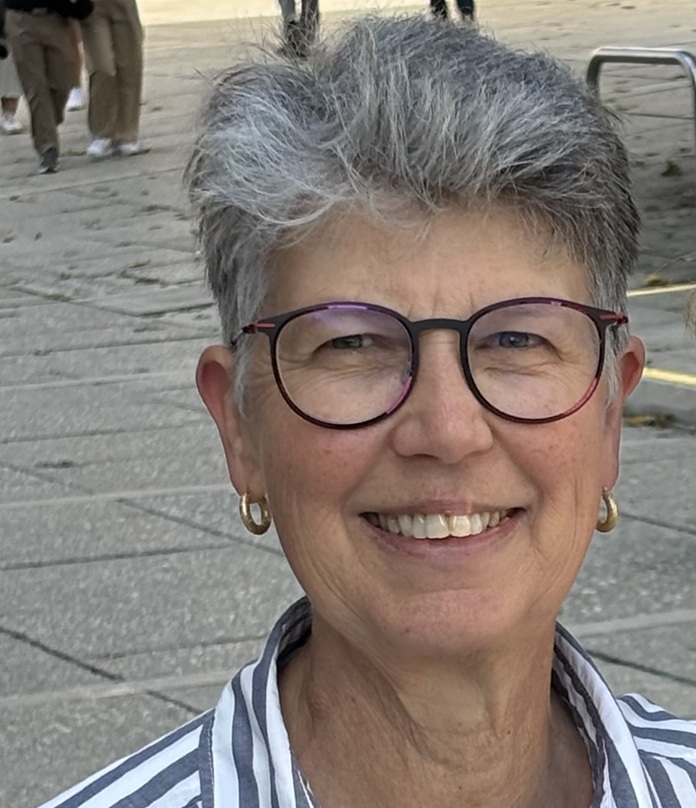
There’s a two-hour time difference between Calgary and Toronto, but Calgary resident Orysia Cox is an avid member of the Toronto Knitters Guild. Read on to learn the way that Orysia came to knitting, why she surrendered monogamous knitting, and how both numbers and needles make her happy.

As an out-of-province knitter, what prompted you to join the Toronto Knitters Guild?

When a longtime member explained that the Toronto Knitters Guild welcomes out-of-province members, I joined in the spring of 2024. What appealed to me was the opportunity to meet and learn from other knitters, along with the incredible slate of guest speakers. Also, I lived in Toronto in the 2000s and, although I wasn’t a knitter then, look back fondly on that time!

How did you come to be a knitter? Do you have ancestors or relatives who introduced you to knitting?

With my Ukrainian roots, I grew up cross-stitching. I spent many hours with my mom and both grandmas cross-stitching blouses for Ukrainian dancing outfits. I loved creating and the joy of handmade, but in my twenties started to experience nerve pain in my wrists. That’s when I first took up knitting. My paternal grandma was an avid knitter who amazed me with her ability to knit socks on small needles with thin yarn, but, sadly, by then her dementia was at an advanced stage, so I learned to knit on my own. I started English style, but that stirred up my nerve pain. Then in 2014, I took a basics course in continental knitting which seemed to stick. Been at it ever since!

Do you have an aptitude for knitting?

I am in Human Resources and oversee the numbers side of the group—compensation, stock options, benefits, retirement/pension plans, data analytics, and so forth. I spend about 75% of my workday in spreadsheets, so math comes naturally. To create a fabric and an object at the same time is compelling, and math is at the core. My gauge swatches aren’t always accurate, and I have been known to frog a project when swatches lie, but I can rely on my math!

Do you accept the proposition that knitting is about “mindfulness”?

Yes! Thinking about picking up the needles when at work, or enjoying the results of a FO brings peace, appreciation for the hard work and “hands-on” (sorry, bad pun!) knowledge, and fondness for the humility of the project’s learnings grounds me. After the workday is done, slipping into the meditation and mindfulness of knitting helps me unwind from the day. That said, knitting fit more into a job I previously held for four years that involved extensive business travel; I would ensure my work was done so I could knit on the plane (sock projects are much smaller to work on when flying than a laptop and files).

When I started to knit I was essentially a process knitter as there was so much to learn. Now, I consider myself a product knitter. Granted, I will search for a project with an interesting construction technique or new thing to learn, but once I have completed the learnings or technique, I am back to the product knitter mindset!

Since 2014 when you learned to knit Continental have you ever injured yourself knitting?

Yes, and I highly do not recommend it! I was a fierce monogamous knitter—no lingering UFOs! A project had to go from start to completion or it was frogged. (I do not like a lot of things on my to-do list.) I was working on an all-over seed stitch cardigan with a very rustic wool and had to tug a bit extra on my purl stitches to maintain gauge. Well, that ended up in a three-month hiatus of knitting, repeat trips to my athletic and massage therapists, and daily exercises I continue to do. Now I rotate projects of different needle sizes or materials and varying yarn weights or types or fibres. This has helped, along with listening to my body when it is time to stretch or stop for the day.

What is the biggest improvement you have seen in your knitting over the last 5 years? How did that improvement come about?

The biggest improvement I have seen in my knitting came about as I was fortunate to be part of Suzanne Bryan’s Bootcamp series. I learned a tremendous amount in the weekly lessons from the technical architecture of a stitch to properly gauge swatch calculations to how to have confidence in my knitting. I owe Suzanne a debt of gratitude; she is truly remarkable.

In 2022, I knit a pieced, all-over lace top (Gramercy Park by Patty Lyons) of which I am most proud. It was the first time I seamed an all-over lace top, had to modify the lace design when doing shaping for shoulders and necklines, and trust my measurements. This top comes out all year, for evening events at the Calgary Stampede to cold wintry days in the office.

How do you go about establishing gauge when you knit?

Swatching may not be my favourite part of knitting, but I have learned that it is critical. Before starting a project that heavily relies on gauge, I swatch. A 15 cm x 15 cm sample can be too small, especially for in-the-round swatches, so I dedicate the time to larger gauge swatches. I take gauge measurements unblocked, blocked, and hung for 24 hours so I can appreciate how the yarn will behave with the needle size/material I have chosen and gravity once it has been worn. I also learned from Ann Budd to keep the decimal places for my 2.5cm/1inch results, rounding only to the nearest whole number for the 10cm/4inch results. This allows for the partial stitches/rows or rounds to be accounted for—impactful when doing an adult garment!

What are your knitting preferences?

My first love is socks, and I will wear them year-round as Alberta’s humidity is lower than Ontario’s and our weather changes quickly with Calgary’s proximity to the mountains. Given this, I have a large amount of fingering weight yarn which is my go-to for garments, shawls, hats, and anything else I cast on. I knit with wool and have been trying to support/knit with different breeds (outside of Merino) to expand my knowledge base.

I enjoy a good Stockinette stitch in the round. I love watching Korean dramas on Netflix on Friday evenings (my husband is shocked I am not yet fluent), and this allows me to read the subtitles and get some progress on a project. Message me for show recommendations!  🙂

Posted on

Kat’s Craft Corner—A Dream Come True

Kat's Craft Corner logo

Congratulations to guild member Katherine McLeod! Her new store, Kat’s Craft Corner https://katscraftcorner.ca/, will officially open the week of December 8, 2024, and her longstanding dream will become a reality.

“I played with the idea of a store for years,” Katherine says. “Wouldn’t it be cool? Or, When I retire…” Then, like knitwear designer Shirley Paden, Katherine faced long-term disability, a state that turned out to be a blessing in disguise. “What helped me then was knitting, crocheting, and other fabric arts, and I realized I wanted to start a store now. I wanted to wake up every morning excited about going to work!”

It took Katherine roughly three months to conduct market research, develop a business plan, source suppliers, and average commercial space costs. “Three months to feel comfortable enough to act and go ask the bank for money,” she recalls.

Kat’s Craft Corner is located at 688 Hortop Street, Oshawa, Ontario, L1G 4N6. Guild members can shop in person or online.

When customers first walk into her store, Katherine hopes they experience a sense of hygge, that coziness which brings about contentment and a sense of well-being. She wants fellow makers to appreciate the mindfulness of fibre arts, to care for themselves, and to deepen their appreciation of the art of knitting.

Over half of the products at Kat’s Craft Corner have been sourced, produced and/or dyed in Canada—from Pictou, Nova Scotia, to Okanagan, British Columbia. In addition to knitting supplies such as Kollage Square Needles, the store will offer other fibre arts such as embroidery and needlepoint.

Katherine is passionate about making higher quality fibre arts accessible to more people, and her love originates with her ancestors. “Many women on my mom’s side used fibre arts to destress, support their family, make family heirlooms,” she says. “They bonded with younger generations by teaching needle point, knitting, and crocheting. And my paternal grandmother was an artist; she and I bonded through creativity and art. So, I remain close to the amazing women in my family even if they are no longer present.”

Where to next? “My fondest hope,” says Katherine, “is to include more Canadian suppliers and extremely well known (but also very expensive) international brands such as Malabrigo and La Bien Aimée. I also want to increase the shop’s bricks-and-mortar square footage and strengthen the fibre arts community in Canada as a whole with a focus on knitting and crocheting.”

Best of luck with Kat’s Craft Corner, Katherine. The Toronto Knitters Guild is rooting for you!

Instagram: https://www.instagram.com/kats_craft_corner/

Facebook: https://www.facebook.com/KatsCraftCornerOshawa

Posted on

Member Spotlight: Mary Tarr

Headshot of Mary Tarr

For our December 2024 Member Spotlight, we invited Mary Tarr to tell us about herself. Mary is a member of TKG’s board of directors and serves as our secretary. Read on to learn what prompted Mary to knit and how much she loves natural fibres.

Tell us about when and how you came to be a knitter.

I came into knitting out of an academic fascination with Angora goats and mohair fibre, after hearing an interesting story on the radio. I discovered that there was an Angora goat farm and woolen mill less than an hour away from me—Wellington Fibres. When I got there, I didn’t know what I wanted. I just knew I wanted something with mohair. The gal in the shop double-dog-dared me to learn how to knit and sold me a lace shawl kit/pattern and a set of Kollage Square needles. Being the kind of person to never back down from a dare, I took the challenge and taught myself how to knit. I watched a lot of YouTube videos, learning what I needed when I needed it, and I have been knitting non-stop in my free time ever since.

Do you feel you have an aptitude for knitting? If so, what skills/abilities come naturally to you?

Yes, I’d say so. I love solving puzzles and have an aptitude for finding things, noticing patterns, and fixing things. I learn best by watching and then going off in secret and figuring things out; I mentally take something apart to determine how it is put together. This propensity has played out in addictions to games such as Tetris, Minesweeper, Solitaire, 2048, Bejeweled, and Candy Crush. Knitting takes up that time now, although I do one Sudoku every day, emailed from my dad.

I also have an unusual affinity toward wool and other natural fibres. When shopping with friends during high school, I was more interested in guessing the fibre content percentages than whether  or not a garment looked good on them.

I loved wool from an early age. My parents had several beloved wool garments—Mom for fashion, Dad for function. Mom’s was full length camel wool coat reserved for special occasions.  Dad’s was a wool Pendleton shirt that he bought with his first “real” paycheck and a bulky rustic wool sweater that “saved his life” on a cold and wet canoe trip in the Boundary Waters.

I also had many “little lamb” toys as I was the only kid I knew named Mary.

Which weights and fibres do you most like to knit with?

I have two favorite yarns because of the personal connection I have with the Ontario people who sell it and their connection with Kollage Square Needles:

  • Wellington Fibres: from its own Angora goats, Mohair/wool yarn milled/spun and dyed onsite.
  • Trailhead Yarns: Plant-based yarn with fun indie-dyer colourways. I like the challenge of combining the different bases—Tencel (lace), linen (lace) & cotton (fingering)) to make gauge for a Sport/DK pattern in wool.

How would you describe your knitting philosophy now?

I believe in making mistakes. Tinking and frogging are no big whoop. It just means I get double the money for my yarn.

Knitting provides the visual and auditory satisfaction that I used to get from Candy Crush and other video games. Now, instead of wasting time staring at a screen, I have something to do in real life and in the end produce an item that is hand-made, three-dimensional, and beautiful. My hubby was very supportive of my switch from Candy Crush. Before that, I would be “tuned out” with my device. Now we can hold a conversation while I knit-knit-knit, though he knows not to expect a response when I’m counting stitches. He also loves seeing how much joy I get from knitting and making beautiful things.

Where do you get your inspiration?

I have followed several knitting podcasts since I started knitting. I enjoy knitting along to the conversations, getting the inside scoop on knitting lingo, techniques, patterns, designers, trends, and all the yarn. I love learning something new: I love a challenge. I love colour. I love texture.

I also get inspired by talking to other knitters, seeing knitting through their experiences, and imagining how I can incorporate that new perspective into my own knitting.

What is the biggest improvement you have seen in your knitting over the last 5 years? What accounts for that improvement?

When I first learned how to knit, I made a goal to knit “Lane Pullover,” a pattern by Jennifer Beale, and I strategically built the skills needed, as I do generally when choosing projects.

Who are the knitters that you most admire?

When knitting the “Lane Pullover,” I noticed one of the colourwork charts was backwards.  I sent a message to Jennifer Beale (my favorite designer) and was invited to become one of her test knitters. I was thrilled! The challenge of knitting to a deadline as well as knitting along with a group of like-minded test knitters keeps me engaged and accountable. My WIPs get FO’d.

What knitted item are you most proud of?

I am proud of them all. They each had something to teach me, and each lesson I learned was important.

What is your day job? How, if at all, does knitting fit with that?

In my twenties I worked as a wildlife biologist for the US Forest Service studying the Northern Goshawk. In my thirties, I was on the development team for the avionics of AgustaWestland AW139 helicopter. In my forties, I provided process assurance for certification of multiple aerospace development projects. Throughout this time I have had hobbies in dog agility, quilting, running, beekeeping, ski instructing, knitting, crochet, spinning, and birding. I love learning new things that keep my mind and my body engaged.

How long ago did you join the Toronto Knitters Guild? What prompted you to join? Is the guild delivering what you hoped for?

I joined TKG three years ago, looking for a local community of fibre friends.  During the pandemic, I had (still have) a group of knitting/crafting friends, but they all live too far for regular in-person outings.  Last year when TKG had a “call for volunteers”, I raised my hand to participate, and am enjoying learning how the guild operates and the amount of work and care goes into this all-volunteer organization.  The people of this guild come from many different backgrounds with a common language of knitting and all-things-fibre.  I think that’s pretty awesome.


Posted on

Silk: A World History

Cover image from The World History of Silk

a review by Genevieve Chornenki.


Silk, that strong, luxury fibre that adds shimmer and elegance to knitting yarn! While admiring it online or in your local yarn store, have you ever considered its past? If not, put your needles down and your feet up. Open the pages of The World History of Silk by Aaarathi Prasad and prepare to be enlightened.

Silk comes from the protein that has been separated from the gummy glue that holds a moth’s pupa or cocoon together. In most situations the moth that is forming inside is not allowed to emerge but is stifled (read killed) by heat or chemical means so that an unbroken fibre can be wound. If the moth emerges, as it is allowed to do in some cultures or circumstances, the silk will be broken or interrupted.

Silk comes from a variety of creatures and several different moths. (See image of four different silk moths.) In the winter of 1935–36, Chanhu-daro, an Indus civilization site now in Sindh, Pakistan, was excavated. Tiny steatite beads were uncovered, strung on forty or fifty strands of silk that had been twisted together sometime between 2450 and 2000 BCE. The silk did not come from mulberry silkworms that are the source of most of today’s silk, but from the cocoons of the wild Saturniidae family of moths.

As for commercial silk worms, Bombyx mori, farmers south of China’s Yellow River were already domesticating them in Neolithic times, and ornamental silkworms cast in gilt bronze or carved in jade have been recovered from graves. An exceptional one was carved from a ten-millimeter sliver of the tusk of a wild boar.

Most of the local makers around the world who collected or cultivated silk and employed dying, spinning or weaving technologies will forever remain anonymous (just as those working with wool, flax, cotton and other fibres). Even so, Prasad introduces readers to people—botanists, illustrators, and merchants—that few of us would recognize. Maria Sibylla Merian (1647–1717), for instance, produced engraved and etched plates of flowers and moths based on years of observation, detailed studies, and time-consuming breeding. It was she who first noted that a moth’s wings form even while the creature is in the larval stage.

Prasad has a PhD in molecular genetics from Imperial College London and later trained in bioarcheology. She never shies from the distasteful aspects of silk production, but her affection for the creatures that yield silk makes for gentle and relaxing reading.

Posted on

4×4? No, swatch some more

Book cover of The Ravell'd Sleeve

by Twisted Cord.


If you’re dead set against swatching at all or beyond 4 inches by 4 inches, Catherine Lowe understands. In The Ravell’d Sleeve, she calls swatching (and blocking) “the outcasts of the hand-knitter,” and she concedes that these preparatory steps interfere with a knitter’s “immediate gratification.” So those of us content to knit items where gauge matters little such as scarves or cowls can carry on. But those who want to up their game—to produce reliable and elegant fabric, to knit garments with flawless fit, refined details and construction, items that wear and hold their form over time—might want to revisit the notion of swatching.

For me, a maker who has knit the tiniest piece, pulled out a tape measure, measured from edge to edge, fudged the math, and then unravelled the swatch, Lowe’s book was frighteningly rigorous. (Did I mention using my sewing machine to take in an oversized sweater or shorten sleeves?) She champions gauge swatches that yield the most reliable information about the fabric of which a garment will be made.

Lowe is not an opinionated knitter or an advocate. She is a thorough and factual one who understands that technique is inextricably linked to technicalities. She explains why a swatch must be knit using the very make and size of needles (not just the same size), and the very yarn and dye-lot that the knitter will use in the actual garment. And her case for a larger, properly blocked swatch with those prerequisites—at least 12” x 12” in size—is compelling:

  1. Edge-to-edge measurements yield an inaccurate gauge. Side-edge stitches are not whole stitches but rather incomplete ones not held by neighbouring stitches. And cast-on rows can be 1.5 times higher than a row of regular knitting, while cast-off rows can be on one-quarter of that height. When these discrepancies go into the computation of gauge they produce inaccurate results.
  2. A small swatch cannot replicate how a knitter really knits and hence how a knitter will actually knit the garment. Putting it another way, a small swatch will not reflect the variability in a knitter’s technique owing to stitch pattern, fibre type, needle size, let alone their emotional state. Nor does a small swatch account for the gestures and adjustments that a knitter unconsciously makes each row—pausing and moving stitches along the barrel of the needle, for instance, or re-tensioning the yarn in the hand.
  3. Blocking (by whatever means) alters both the dimensions and hand of the fabric. Handknitting tends to “relax” when blocked or finished (by washing or dry cleaning), and the degree to which this happens cannot be accurately anticipated. “A gauge swatch that has not been finished in exactly the same way the knitter, or the owner, intends to treat the completed garment,” writes Lowe, “can only hint at those stitches and row counts that will ultimately determine the dimensions of the garment.”

The Ravell’d Sleeve contains chapters of over twenty pages on each of swatching and blocking, and I don’t pretend to have absorbed all of its wisdom. But I stand by it as a go-to reference book for any knitter willing to move beyond received wisdom about the much maligned swatch

Posted on

Quilts: Made In Canada

A photo of a quilt from the ROM website

by Emily Chatten.

On Saturday, October 19, 2024, the Toronto Knitters Guild organized a guided tour of the Royal Ontario Museum’s exhibit “Quilts: Made In Canada,” and over twenty people attended. The exhibit included a range of quilts from primitive to spectacular, utilitarian to art, wedding gifts to quilts made for the war-weary following World War II. While not a quilter herself, our guide had spent time learning about the history of quilts and quilting techniques in Canada. The museum owned the majority of the quilts on display with a few borrowed from the collections of other Canadian museums. Unfortunately, there were no recorded details of the oldest quilts, but the visual details of all of them told stories to even the most untrained eye.

As with any textile exhibit, the delicate nature of the materials requires dim lighting. While this is important for textile conservation it made it difficult to appreciate the detail of the handwork that went into these exceptional pieces of Canadian history. Visitors might have benefited from enlarged pictures showing minute or dark details that were difficult to see in gallery’s dim lighting.  And while there were some interactive opportunities such as looking at tools and quilt piecing toward the end, having scraps of fabric that people could touch might have been grounding for folks who did not grow up in a household with quilts.

Visiting “Quilts: Made In Canada” was filled with nostalgia for me. Many of the quilts put me in mind of visiting an aunt and finding her with her friends, sitting and working around a quilt on a frame. Later in the year, if they were lucky, the work would pay off with a prize at the local agricultural fair.

As we walked through the exhibit, it seemed that if I blinked for just a second, the quilt we were coming to was on a frame surrounded by a group of women, enjoying each other’s company as they worked on a quilt for one of their households. Then I was back at the ROM.

Emily Chatten is a Toronto-based maker whose rural ancestors saved every scrap of available fabric to make things for the home.

Image source: Royal Ontario Museum