The new guild season starts in October. Current and new members can all attend the September meeting. This season’s Board of Directors includes new faces and returning officers. Look for a call for volunteers to support various committees that are forming.
Greetings
Hello Toronto Knitters Guild! I hope this letter finds you in good health and good spirits. I am Mary Tarr, TKG Secretary ‘24-’26, and newly elected President for ‘26-’28. As we are preparing to embark on a new Guild season, I wanted to take the opportunity to introduce myself and share some of my thoughts.
Membership Season
Toronto Knitters Guild season goes from October to September with a two month summer hiatus in July and August. The upcoming September meeting is “Officially” the last meeting of the 2025-26 Season. New Memberships purchased for 2026-27 season include the September meeting, knit night, and all benefits of membership (discounts, etc). Active members have the entire month of September to renew prior to the Official start of the next guild season in October.
Old Board/New Board
This new season starts with sincere gratitude for the dedication and hard work of our Board of Directors.
Departing board members
Deborah Roed and Genevieve Chornenki
Two past presidents who will continue in an advisory role (non-voting)
Sara Joyce and Cathy Briant
Continuing board members
Kristen Pytlowana, Danielle Taylor, Joanna Fromstein, Sarah Dawn Adams, and Samantha Chezy
New board members
Warmest welcome for our newest board members joining us in the roles of vice president and secretary, respectively:
Phaedra Livingstone and Jennifer Webster
All hands on deck
Our Board is awesome, we are dedicated volunteers, but we are spread very thin. Several individuals have taken on multiple roles over the past several years which is not sustainable long term. Life events happen. Every volunteer should feel supported with back-ups and contingency planning, so when sh*t happens, we aren’t worried about guild stuff. My goal as president is to build up our committee membership, distribute workloads and get more hands on deck without adding more work for our beleaguered crew.
In order to accomplish this I will:
Reduce barriers for volunteers
Find user-friendly technologies for communication and collaboration
Identify tasks that can be streamlined, combined, or split.
Define clear roles and time commitments
Newsletter, knit night, events planning
Bite-sized commitments (e.g. one month contributions)
Co-work/two-person team (alternating months, or collaborate with a friend)
Committee openings
Special Skills / Consultants
Provide incentives for volunteering
Membership Fee reduction
Resume content- Career / Skill Building, Volunteer experience
Letter of Recommendation
Mentoring / Menteeing
We need you, our members, to lend a hand if you are able, to keep this wonderful guild operating. I will ask for your patience as we learn how to manage new volunteers, communications, training, etc. while also keeping everyone’s workload manageable and within the guild’s vision, mission and values. I am confident that once we get started we will have smooth sailing (and lots more time for knitting).
Closing
In the lead up to October, the board will be planning the guild’s budget, calendar and committee needs and goals. Keep an eye out for volunteer sign-ups.
I’m looking forward to the upcoming season and reuniting with you all.
Sincerely,
Mary Tarr
President,
Toronto Knitters Guild
Celebrating the Joy of Yarn
TKG Vision/Mission/Values
Vision
We foster a supportive and welcoming fibre community, encouraging learning, inspiration, and sharing the joy of yarn.
Mission
We facilitate learning and social activities and opportunities.
We provide platforms to connect with those that are in the fibre industry.
We offer opportunities for the Guild to respond to the needs of the community.
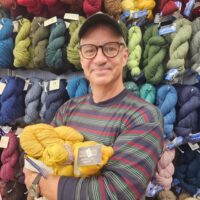
Kirk clutching several skeins of yellow yarn in front of a wall filled with colourful yarn hanks
This month’s member spotlight features Kirk Dunn, a longtime member of the TKG who currently acts as a co-host for our monthly virtual knit nights (along with TKG past-past president, Cathy Briant). Read on to learn more about Kirk. And afterwards, if you missed it, we highly recommend you watch the recording of our December 2025 Monthly Meeting when he talked all about his Patchwork Pride project and its adventures both locally and in the UK, where it was displayed prominently outside Canada House in the summer of 2025 for London Pride. The video can be found in our Membership Hub on the Meeting Videos page.
How long have you been a member of the Toronto Knitters Guild? What prompted you to join? What is it that the Guild satisfies for you?
I cannot remember how long I’ve been a member! I started coming to meetings back when the Guild was known as its former iteration, “The Downtown Knit Collective.” We met in the big meeting room at the YMCA on Grosvenor, and I remember giving a presentation there about my project “Stitched Glass,” which must have been around 2004 or 2005 or so.
Tell us about when and how you came to be a knitter. Do you have ancestors or relatives who introduced you to knitting?
I became a knitter as a young actor. I had just graduated from Theatre School, and my first acting job was a kids’ theatre tour all over Ontario. We were doing a show sponsored by the Ontario Women’s Directorate about gender equity: girls can do what boys can do, and boys can do what girls can do. In the show I played a 12 year-old-boy who had an “anything you can do, I can do better” relationship with his best friend, who was a girl. This relationship spilled over into our life off stage as well. If I said I was going to get up at 6:00 AM and go swimming in Lake Nipigon, then she said she was going to get up at 6:00 am and go swimming in Lake Nipigon. One day, up in Wawa, we were browsing through a trading post when I found a sweater I considered buying. My friend said “Pfft! Buy that sweater? I could knit that sweater.” So, I figured, if she could knit the sweater, I could knit the sweater. And that’s where it all started.
Do you accept the proposition that knitting is about “mindfulness”?
Knitting is definitely a ‘mindful’ thing to do. I’ve also heard it described as an “Artists Brain” activity. It’s something you can do with your hands, and just let your mind wander, recharge, explore. Ideas and thoughts drop in, paddle around, hang out, move on, come back, or just fade away. I always leave a knitting session refreshed, refocused, and usually with some tangible progress on some sort of knitting project to show for my time.
What is the biggest improvement you have seen in your knitting over the last 5 years? How did that improvement come about?
I have become more adventurous about trying new cast-on techniques. This is completely due to Youtube and all the instructional videos available. Actually, perhaps that’s the biggest improvement in my knitting – that I am willing to go onto Youtube and learn something new. To be fair, I’m not very good at all these cast-on techniques, but I think that is because there are so many, and don’t stick with any one of them for very long before trying another, so they never really get locked into my muscle memory.
Tell us how you go about establishing gauge when you knit? Or is gauge something you even care about?
I have been very fortunate to have a pretty even gauge. Sometimes it takes me awhile to achieve the correct gauge for a pattern, but that is just a matter of knitting a quick swatch, and then adjusting my needle size up or down. And I’m a big fan of test swatches or sketches. Yes, they are a pain, but they really do help me plan for the project ahead. And because most of my projects are my own designs, I need to not only swatch for gauge, but also for colourways etc.
Which weights and fibres do you most like to knit with? What kinds of things do you knit, i.e. hats, scarves, garments, toys…?
I have, in my past, worked on very large projects, like Stitched Glass, and The Patchwork Pride Project. In those, I was using multiple strands of yarn that would combine to be a very chunky gauge. About five years ago, I wanted to knit a very detailed design on a pair of mittens, and used a fine yarn from Cascade – their fingering heritage, I think it was. It came in LOTS of colours (my big thing), and I was able to use two strands at once, keep my gauge reasonable, and play with mixing colours. Since then, fingering weight has been my go-to yarn weight for my projects.
Because I spent a full 15 years knitting Stitched Glass (a project comprised of three full-sized panels [5.5 ft by 9 ft] in the style of stained-glass windows, exploring the commonalities and conflicts between the Three Abrahamic Faiths), there was a long period of time when I didn’t do any knitting for myself.
Now, I’m getting back to knitting smaller projects for myself and my family. I’ve got a pillow I need to knit for my wife, Claire, and I would like to knit myself a couple of vests. So many ideas, so little time…
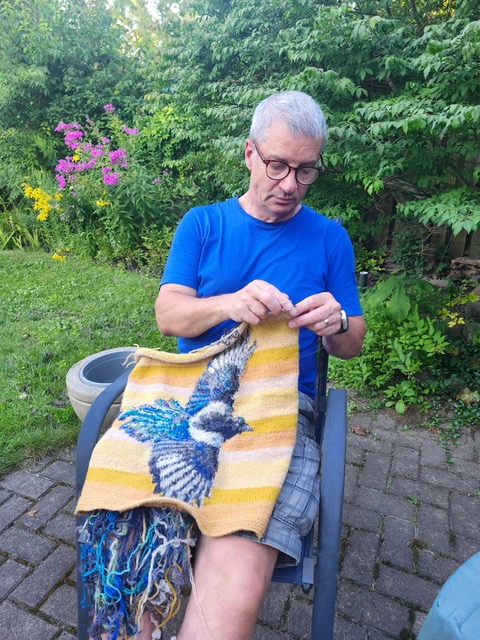
Kirk working on his current project, a pillow for his wife Claire
What knitted item are you most proud of? What did you learn while working on it?
I am proudest of my two largest knitting projects. The first being Stitched Glass, mentioned above. That project was the genesis for writing the play The Knitting Pilgrim with my wife, Claire, which has toured in 6 countries for over 120 shows. The second large project was The Patchwork Pride Project, a huge pride flag comprised of 6” knitted or crocheted squares, sourced from all over the continent and then assembled by the LGBTQI community and their supporters. In 2024 it was hung from the bell tower of Morningside-High Park Presbyterian Church, and in 2025, it was displayed on the facade of Canada House in Trafalgar Square, London, UK. I think the thing that makes me proudest of those two projects is not just the knitting that went into them, but rather what they say: the message they give to the world. Life is about compassion, peace, and empathy for others. Without really realizing what I was doing, I stepped into Craftivism – the art of gentle protest. And that is now a big part of how I see myself, and what I want to do in the future.
What is your day job? How, if at all, does knitting fit with that?
I work as a corporate trainer in the customer service space. I give customer-centric feedback to corporations to let them know how they are being experienced by their customers, and what they can do to improve their customer relationships. Knitting doesn’t really fit in with it, although my company has been very supportive of my work (my boss is one of my biggest fans), and since the advent of zoom I have become adept at knitting just off screen…
Have you ever injured yourself knitting?
Fortunately, I have not. Because most of what I do is colourwork, I very rarely make exactly the same motion for very long – so I’m not prone to any repetitive motion injuries. I’m often stopping to find new yarn, add colours, or work colours in. I’ve developed my own two-handed technique for working with multiple colours and strands, and that keeps my range of motion pretty good.
Do you consider yourself to be a process knitter or a product knitter?
I’m a bit of both, really. I am always knitting with a product in mind – a sweater, a mitten, a blanket, a pillow – but because it is usually my own design, I need to experiment with the process as I go. This is most often about colour, but a few times it has been about shaping and gauge – as was the case for one of the sweaters I knitted for Spycraft, a play Claire and I wrote about a 50-year-old woman in WW II who was tapped by Winston Churchill’s Special Operations Executive (SOE) to spy on the Nazis in occupied France, and sent coded intelligence back to England in her knitting. I was knitting a form-fitting intarsia sweater for one of the actors, and the sizing just about drove me around the bend.
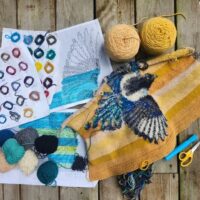
Kirk’s bird pillow in progress, showing the charts, notes, tools and materials needed
Do you have a favourite stitch pattern? If so, what do you like about it?
Sadly, I default to plain old stockinette stitch most of the time. This is because I’m all about colour and I often design representational patterns, and stockinette is a great canvas on which to ‘paint.’ That said, I do have an intense admiration for cables, and would dearly love to knit a Gansey. Perhaps someday…
This month, our feature sponsor to learn more about via our Pick 5 series is Indigodragonfly, a long-time supporter and favourite of TKG. Kim McBrien Evans, Dyer, Designer, Instructor and Author extraordinaire of Inidigodragonfly, will be the TKG speaker at our monthly meeting in November, so read on to learn more about them now, and then and come to the meeting in November to learn more and to meet her and the Indigodragonfly crew in person (and squoosh some of their yarn too!)
What makes your business unique? Tell us about something that we won’t find anywhere else.
The people and the talents they bring to Indigodragonfly. Kim, Ron, and Victoria love humour, nerdiness, and playing with colour. Our colours are multi-faceted, and seem to glow from within. Every inch captures the attention of makers through every stitch. Ron and Victoria’s humour shows up in the colour names, which are often geeky, always clever, and make you laugh out loud. Kim comes in with her sharp and chaotic colour sense to help you choose the best colours for your project, and can advise you on sweater knitting, from choosing a pattern to choosing a size and beyond. And the last thing you won’t find from any other studio, is Kim’s new book, The Knitter’s Sweater Fitting Bible!
What’s your most popular product?
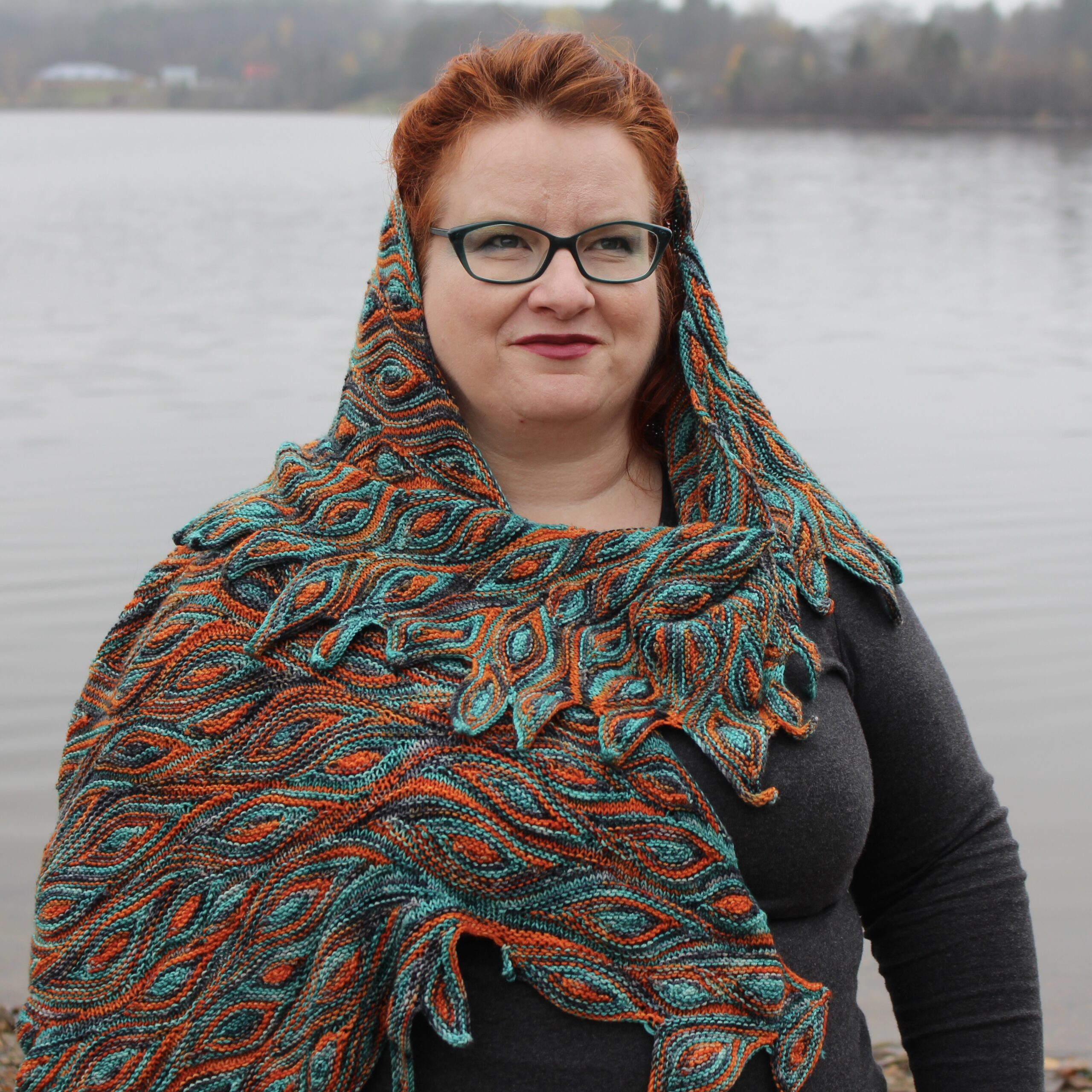
The Impervious Shawl Kit. This kit has been a bestseller since Kim released the Impervious pattern in 2018.
As dyers, we have come up with an endless range of colours for this design–many of them one of a kind. The shawl is fun to knit (and not difficult!), and elicits compliments whenever you wear it!
What product gets undeservedly overlooked?
Most of Kim’s sweater patterns! Kim designs sweaters that look great on bodies of different shapes and sizes, often defying the fashion rules that we grew up with. From slim to plus size, short to tall, to bodies with limb differences, mastectomies, and disabilities, Kim is an expert on sweater fit and fashion!
How does your community contribute to your business?
Community is central to our work. We started because makers asked us to–Kim was approached by members of her Knit Night in 2009 and asked if she would start a yarn dyeing business! We’re still here because makers support us, and that is empowering. In return, we sponsor events at local and national levels, dye fundraising yarns to support other makers and charities we believe in, and we hold events to bring our community together both at our studio and beyond.
Sometimes that community literally helps us develop products! Crowdsourced dyeing over Zoom, for example.
We are unapologetically ourselves and people respond well to that. We’re very proud to be able to run a business that helps us make the world a better place.
What project are you dreaming about doing next?
Kim’s working on a KAL associated with her new book! A year of knitting sweaters, with virtual classes, zoom KAL sessions, and lots of opportunities to learn, get support, and to simply make beautiful sweaters that fit us all–as we are! We hope you’ll join us.
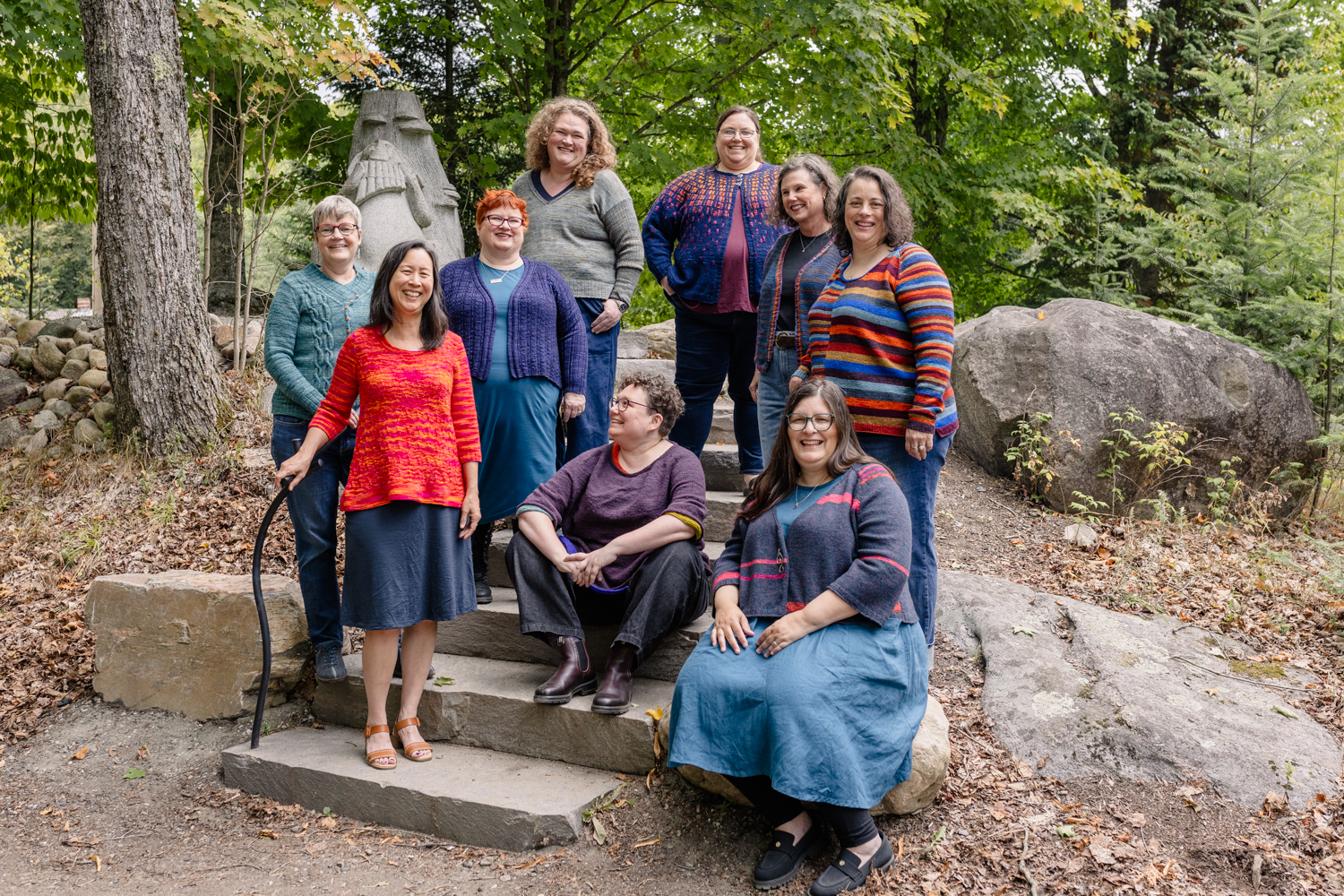
At the Annual General Meeting held on Tuesday May 26th, we elected a new Board of Directors for the 2026/27 season. We are so grateful for the major contributions to the Guild made by those directors stepping down from the Board, and welcome our two new members. The Directors for the 2026/27 season are:
Sarah Dawn Adams Kristen Pytlowana
Samantha Chezy Mary Tarr
Joanna Fromstein Danielle Taylor
Sara Joyce * Jennifer Webster**
Phaedra Livingstone**
*Past President, Advisory
** New Members
Phaedra Livingston has been knitting for almost 50 years and a member of the TKG (off and on) since the Downtown Knit Collective days. She has been an active board member for many local, national and international arts, academic and grassroots organizations for the past 30 years and is keen to contribute her arts administration skills to the Toronto Knitters Guild board. She is especially interested in assisting with programming and community development, as needed. Phaedra was profiled in the October 2024 TKG newsletter, where you can read a bit more about her knitting interests.
Jennifer Webster has been a member of the Toronto Knitters Guild for almost two years. She has volunteered to coordinate the member profiles in the newsletters for the past year. Jennifer has been a knitter for over 50 years. She prefers to knit small projects that can travel with her because she travels a lot for her work as a Vice-Chair with the Canada Industrial Relations Board. Jennifer lives in Parkdale. When she is not working or knitting, she loves to curl, practice yoga, camp, cycle, hike and read. She volunteers with different organizations in her community and has served on Boards for legal clinics in the past, as well as on the Board of the Friends of High Park Zoo.
Stepping down from the Board at the AGM were Catherine Briant, Board Member and Past President, after serving the maximum term of six years; Genevieve Chornenki, Board Member and Director of Programming, after serving four years; and Deborah Roed, Board Member, after serving two years. The Board thanks Cathy, Genevieve and Deborah for their commitment of time, energy and fresh ideas to the Guild. We are so much stronger for their contributions.
The Committee Reports presented at the AGM have been posted to the Guild’s website in the Membership Hub. They contain a wealth of information of interest to members and to anyone considering volunteering their time to one of the committees next year.
Annika Scheer of Rosemary and Pines Fibre Arts in Germany is a longtime scrap yarn enthusiast and has recorded several videos on her popular YouTube channel on how to use up scraps and single skeins. She has also created an inspirational bundle of scrap knitting patterns by various designers on Ravelry — check out RosemaryAndPines > Notebook > Favourites > Bundles > Scrap Knitting Projects, or see Ravelry.
Some of the designs featured in this bundle include Wool & Pine’s glorious Sea Glass series of sweaters, featuring a DK weight main colour, and a multitude of colourful fingerweight scraps held double, in a simple 1×1 stranded colourwork pattern. All yarn requirements are stated in grams, so you can weigh your scraps and leftovers before beginning. Their Voyage cardigan uses fingering weight leftovers in various colours and bands of geometric patterns for the body, offset by solid sleeves and bands. See Voyage by Wool & Pine on Ravelry.
Wool & Pine’s Sundial Tee is a cap-sleeved top for warmer weather. It features colourful mosaic strips in a slip stitch pattern, great for using up leftovers and mini skeins. Instructions provide yarn weight in grams needed to complete each interlocking mosaic stripe.
Interested in playing with marls? Designer Summer Lee offers the Stash Dive Raglan pullover with a choice of necklines, which knits up quickly with a worsted and a fingering weight yarn held together. The pattern includes a video tutorial on working with scrap yarns to create a marled effect, and tips for dealing with scrap ends.
Our friends at Knitty.com, the longest-running free knitting magazine on the web, regularly publish new free patterns that make great use of leftover yarns and mini skeins. The current Spring-Summer 2026 issue offers three new patterns specifically designed to make effective use of scraps and partial balls :
Anna Hyatt’s Scrapple, a pair of scraptastic handwarmers, which would be an ideal beginner project in stranded knitting.
The Knitty.com Winter 2025 issue features four more inspiring scrap yarn patterns:
Kate Harvie’s Kaleidoscope – sleeveless sweater using DK or fingering weight yarns of any length and slipped stitches to create a vivid textured fabric.
Revisited by Veronica Ory – a large fringed scarf with contrasting stripes of dark and light/bright colours running lengthwise and slipped stitches to add texture. To amp up the fun factor, put your light/bright colours in one basket, and your darks in another, and alternate at random.
Oddment – a half -circle shawl by Taylor Rutledge combining garter and eyelet stitch texture with stripes of varying widths in a cornucopia of colours of sock yarn, using individual balls from 0.75 to 20 grams.
Thrumline, by Gillian McLeod, is a tubular scarf knit in worsted weight, studded or ‘thrummed’ with jewels of leftover yarns of all weights and colours.
Fans of Modern Daily Knitting (MDK) love their Field Guide collections of themed patterns. Field Guide #16, Painterly, includes new designs from Kaffe Fassett, famous for his mastery of colour and multiple yarns. Villages and Cityscapes are both scarves featuring simple intarsia in geometric shapes using small amounts of many colours. Field Guide #13, Master Class, features new Fassett designs in colourful stripes, including a garter stripe shawl, scarves, a cowl, and cushions.
Like many of us, my New Year’s resolution was to knit down my yarn stash, which seriously exceeds my life expectancy. In particular, I sought ways to use the many partial balls left over from other projects to make something beautiful from nothing. If there was a chance to incorporate learning a new technique, all the better. I was interested in projects that would inspire knitters to mix and match leftover yarns to knit something unique and beautiful.
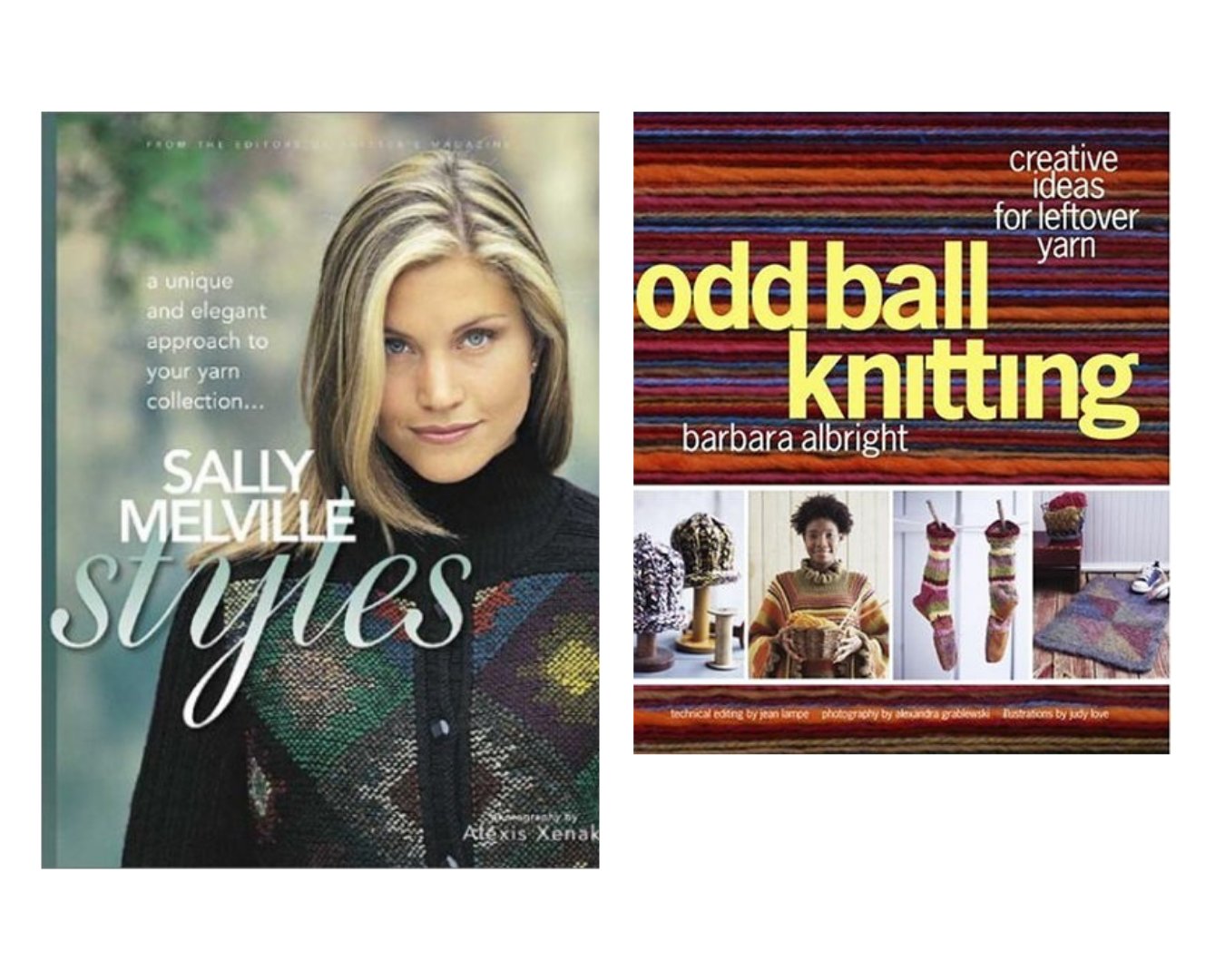
Where to look for inspiration and advice? Books, YouTube, online knitting sites and Ravelry are all possible sources. As a lifelong bookworm, I started at home, in Canada, with knitwear designer Sally Melville. Sally was way ahead of the eco- and wallet-friendly curve when it came to using up stashed and leftover yarns. Her brilliant book, Sally Melville Styles: A Unique and Elegant Approach for Your Yarn Collection, is available on loan from the Toronto Public Library, for sale through the For Sale or Trade tab on Sally’s Ravelry patterns page, or through online independent booksellers ABE.ca and Thriftbooks.com. It includes useful advice on organizing your stash visually to facilitate mixing yarns and colours. If you prefer to learn by video, Sally has an online class on Craftsy.com, Stashbusting Secrets for Sweaters and More, which is packed with useful design tips for mixing yarn weights and colours. See https://www.craftsy.com/class/stashbusting-secrets-for-sweater-knitting-more. Sally’s pattern “Necessary Neutral” is a great example – colourful mitred squares in leftover sock/fingering weight yarns are set off against a pale or dark neutral background in a beautiful wrap in two sizes – no need to worry about fit: https://ravel.me/necessary-neutral.
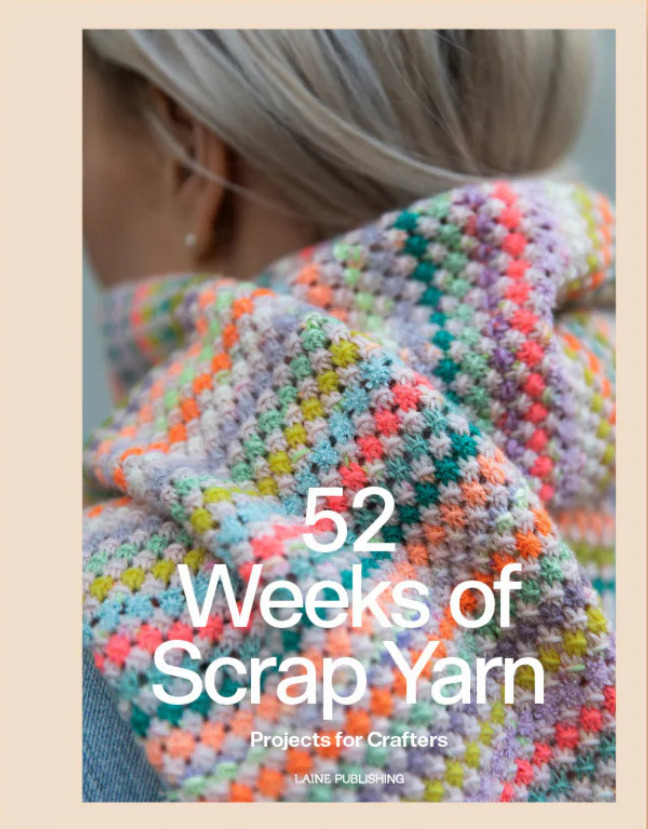
Another wonderful source of inspiration is 52 Weeks of Scrap Yarn, Laine Publishing’s 2025 entry in their very successful “52 Weeks” series. It is a visually beautiful book, offering a wide array of stunning knit and crochet projects using scrap yarns, ranging from sweaters, to shawls, socks, hats and other accessories, to home decor. A hardcover copy sells for C$70 and is not yet available from the Toronto Public Library, although TPL has many of the previous 52 Weeks series. Before making the investment, I recommend checking out the reviews on YouTube by A Lovely Yarn and Rosemary and Pines Fibre Arts.
Barbara Albright’s Oddball Knitting: Creative Ideas for Leftover Yarn, published in 2004, is a comprehensive resource, offering useful advice and a well-organized index to over 30 new patterns for using leftover yarns of various weights, with a section dedicated to reversible scarves. It’s available on loan from TPL, for sale or trade on Ravelry, and second-hand on ABE.ca and Thriftbooks.com.
The Ravelry.com website offers an absolute treasure trove of scrap yarn project ideas, and I’ll focus on these in Something from Nothing, Part 2, in the June TKG newsletter, along with other sources of online knitting inspiration available to you. Our friends at the amazing member-supported Knitty.com, for example, have been huge supporters of new designs for scrap yarn projects, and I’ll also highlight some of their new patterns next month.
On Saturday, April 11, with the generous support of The Knitting Loft and Estelle Yarns, we were thrilled to welcome Arne & Carlos to Toronto—and what a night it was. Calling it a success hardly does it justice.
We arrived early to set up for the 7 p.m. start, only to find eager attendees already in their seats – needles in hand – knitting, chatting, and buzzing with anticipation. Nearly 30 people had arrived before Arne & Carlos themselves, happily settling in for an impromptu “pre-show” as they watched the setup unfold. The energy in the room was unmistakable from the very beginning and only grew stronger as the evening went on.
An ABBA playlist set the tone as the room filled with knitters and crocheters sharing stories and excitement. Cheers erupted as guests called out where they’d travelled from—Detroit, California, Bermuda, across the U.S., and even Paris, France! Some came with friends, some solo, some to celebrate special occasions—but all came for their love of Arne & Carlos.
And that love was clearly felt. Arne & Carlos took us on a heartfelt and often humorous journey through their careers—from their individual beginnings to their work together, from high-fashion runway designs to the knitwear creations and patterns we know them for today. Their stories were inspiring, personal, and delivered with their signature warmth and humility. They generously stayed on for a lively 30-minute Q&A, fielding questions that ranged from design insights to creative inspiration—and even a bit of gardening wisdom.
One of the most touching moments of the night came at the end of the presentation, when attendees proudly held up their finished Arne & Carlos pieces. The room lit up with creativity and admiration, and we later learned how meaningful it was for Arne & Carlos to see their work brought to life in so many unique ways. Thank you to everyone who shared—it truly made an impact.
We wrapped up the formal portion of the evening by celebrating 36 door prize winners, thanks to the incredible generosity of our sponsors. The Knitting Loft contributed ten $50 gift cards, while Estelle Yarns donated an array of prizes, including 24 balls of the new Arne & Carlos Socks and More yarn and 2 copies of their latest book, 65 New Christmas Balls to Knit. The excitement in the room was contagious.
From there, the evening flowed into relaxed socializing—book signings, photos, laughter, and heartfelt conversations. The sense of community was undeniable, with new friendships forming, hugs exchanged, and joy radiating throughout the space.
It was truly an unforgettable evening, made possible by an amazing team. Heartfelt thanks to Sara Joyce, Guild President, for her constant support; Joanna Fromstein, Communications Director, for creating and managing the ticketing system; and Kristen Pytlowana, Treasurer, for her solid support behind the scenes and on-site. Thank you as well to Danielle Taylor, Registrar, for coordinating check-ins with Kristen, and to Ali Moenck and Vanessa Mo for warmly welcoming guests and assisting with door prizes.
A special thank you to The Knitting Loft for months of collaboration and idea-sharing, and to both The Knitting Loft and Estelle Yarns for their generous contributions that elevated the entire experience.
Most of all, thank you to everyone who attended and brought such warmth, enthusiasm, and creativity to the night. It was a joy from beginning to end.
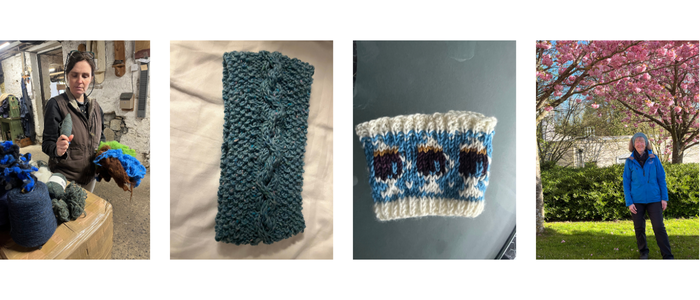
I just got back from the Knit Social Irish Crafting Tour of Ireland, which was the best knitting tour I’ve been on so far. We started in Dublin, went on to Inis Mor, one of the Aran islands, Cork, and Blarney Castle to name a few of the stops and ended back in Dublin. Along the way, we had three knitting workshops, one for cables, one for how to use Doodle cards for colour knitting fun, and one that was colour knitting and steeking with Carol Feller. We crafted silver rings in Dublin and baked bread and scones in a castle kitchen. We got tours of a whiskey distillery, a pottery business, a wool mill and sheep farm, and a few of our group even kissed the Blarney Stone.
The workshop had projects that were appropriate to the length of time we had. There was a mug cozy for the Doodle cards with some information on how they could be used to make a custom colour work cowl. For cables, we got two patterns, a headband or a wine cozy. The headband had one three-cross cable, and the wine cozy had multiple types of cables so you could pick based on experience. At the workshop with designer, Carol Feller, she gave us a fingerless glove pattern to practice our colour work and steeking.
As with any knitting tour, there was lots of knitting time on the tour bus between stops. On this tour, there were informal knitting circles in the evenings. By the end of the tour, many of us had finished projects. I have a mug cozy, a new cable headband and one of the two fingerless gloves completed. I stayed on in Ireland after the tour ended, so that second glove is almost finished.
Needless to say, there was also yarn shopping. This is Knit in Dublin, Hedgehog Fibres, Blarney Woollen Mill store and Cushendale Mill. Cushendale is a working mill from fleece to yarn and even weaves blankets. We got a tour from the current owners.
We had a great group of knitters, from a beginner who had only been knitting for a month to experienced knitters who had been knitting for decades. The consensus was that we all got something out of all the workshops. In addition to the knitting workshops, we also made silver rings and baked soda bread and scones. Also, I have to thank Knitting Tours and Knit Social for planning and running this tour. Melanie and Fiona from Knit Social were great hosts, and Patricia from Irish Knitting Tours was a wonderful guide.
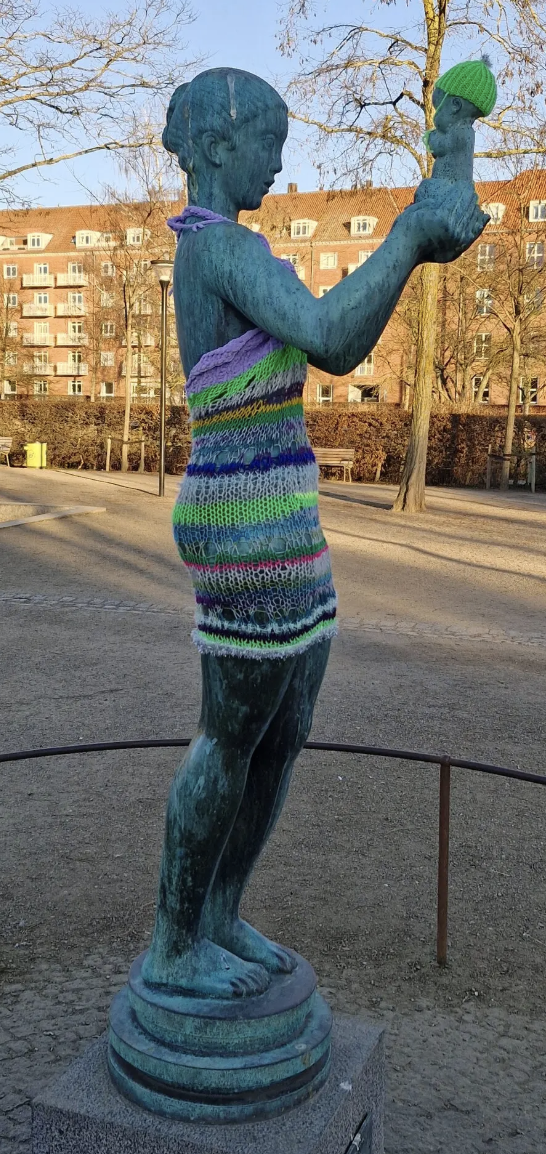
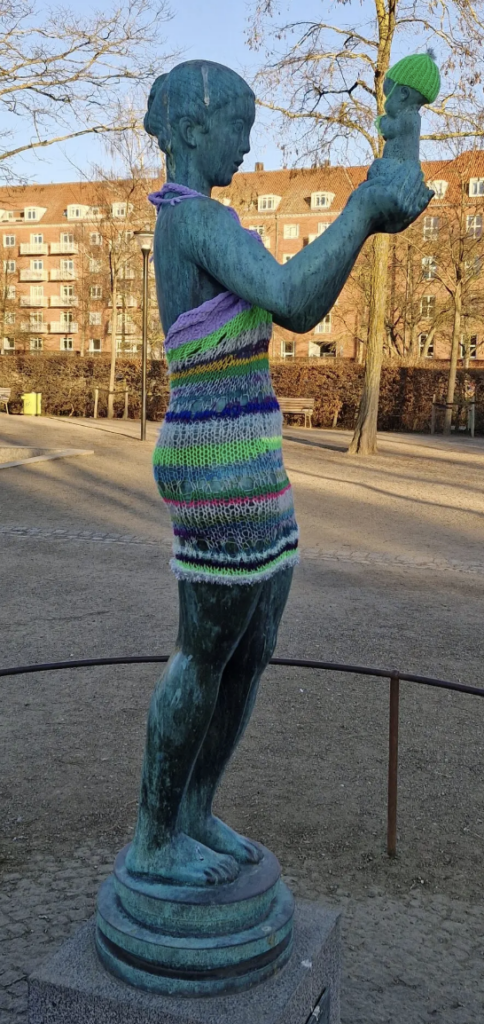
Louise Moerup’s yarn-bombed Venus statue in Copenhagen, Denmark
Until recently, yarn bombing—also known as guerilla knitting—wasn’t my thing. It had the aesthetic appeal of a sink of dirty dishes or a pile of soiled laundry, and military terminology is inconsistent with our gentle needle art. Yet the chaos of yarn-based graffiti is what makes it effective as a public statement or a social critique. One doesn’t ordinarily find a pride flag on a tree, for instance.
Yarn bombing was put to good use recently in Denmark where public monuments of historically-significant males appear ten times more frequently than monuments of females. Avid knitter Louise Moerup wanted to point out that discrepancy, so she knit and dressed one of Copenhagen’s Venus statues in a striped halter dress and thereby started a national conversation. Moerup said that she wanted to highlight the absence of women remembered for their achievements.
Moerup wasn’t concerned with public nudity, apparently accepting the chauvinism built into Western art. But is nudity separable from the numbers? I suggest that they converge in the same prejudice.Female nudes overwhelmingly outnumber male nudes in Western art, but that discrepancy seems to be an acceptable one, and outside gallery walls, the display of female pits and parts goes mostly unremarked. That said, painter John Berger’s observation in Ways of Seeing (1972) may still be relevant:
Men act and women appear. Men look at women. Women watch themselves being looked at. This determines not only most relations between men and women but also the relation of women to themselves. The surveyor of woman in herself is male: the surveyed is female. Thus she turns herself into an object of vision: a sight.
Which brings me to my pending yarn bombing.
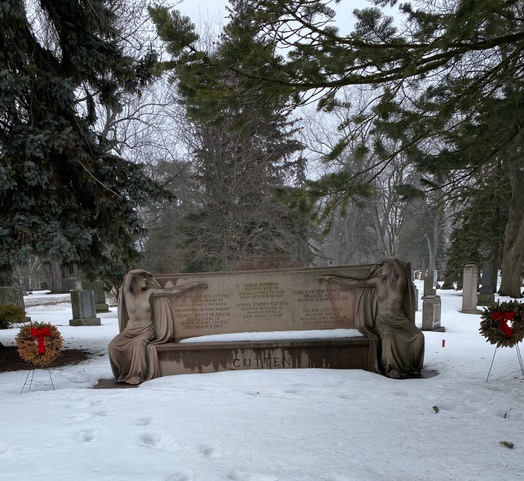
On Plot O, Lot 18 in Toronto’s Mount Pleasant Cemetery, the merchant Lionel Cutten erected a monument with two unclothed figures that, according to The Mount Pleasant Group’s website, are believed to represent Cutten’s wife, Annie Rowena, and her sister, Helen Gertrude Moncur, who died within months of each other. The website describes the monument as one of the cemetery’s “most captivating memorials,” but every time my friend Donna and I pass by we cringe and shake our heads. How, we wonder, is this a dignified memorial to the deceased women? Is there the remotest chance that they authorized these representations?
The Cutten monument, Mount Pleasant Cemetery, Toronto
Annie and Gertrude are seated at either end of a long bench, partially draped in bedsheets, bare arms above their heads revealing hairless arm pits, and smooth, lithe bodies exposed from the navel up. Rain or shine, winter blizzard or summer heatwave, the bare-breasted ladies recline. Berger again:
To be naked is to be oneself. To be nude is to be seen naked by others and yet not recognized for oneself.
Oh, how Donna and I want to offer Annie and Gertrude the dignity of clothing!
Donna doesn’t knit, however, so I’m elected to produce yards and yards of fabric. But here’s the real concern: will the Mount Pleasant Group consider our cover-ups an act of kindness or an act of vandalism?
Thank you to the members of the Toronto Knitters Guild for giving me the opportunity to participate in this fun ‘5 Questions’ feature for your newsletter. I’m sincerely grateful for the opportunity to be included and to share more about A Needle Pulling Thread, KNITmuch, and QUILTsocial with your community.
What makes your business unique? Tell us about something that we won’t find anywhere else.
More Than Magazines, A Creative Ecosystem
What makes my business unique is that it’s much more than a publishing company. Through A Needle Pulling Thread, KNITmuch, and QUILTsocial, over the last 20 years, we’ve created a connected creative platform that blends print publishing, digital education, original project development, and industry collaboration in a way that’s rare in the needlework world. Readers come to us not only for inspiration, but for trusted instruction, expert techniques, and beautifully presented content they can learn from. That combination of editorial quality, niche expertise, and multi-platform reach is something you won’t find just anywhere else.
Tell us about your team.
Needless to say, I have a stellar team. In all, we are 5 dedicated individuals: My husband, who has been a vital part of this journey, joined me on this venture from the beginning. As a professional engineer with an MBA, he thought I would need help with my idea to publish a needlework magazine highlighting primarily Canadian designers. I remember thinking to myself, ‘Oh good, I might need your help…’ Little did I know how much help I really needed, and I’m forever grateful. He’s great at the administrative work, website development, and product development. Most recently, he developed and launched a new marketing product called POSTfeed, which uses AI to automatically distribute brand content to participating retailers’ social media pages. Genius!
Our team also includes an IT/Web Assistant, a Graphic Assistant, and a Social Media Assistant, whose contributions are integral to the smooth operation, creative execution, and ongoing success of A Needle Pulling Thread, KNITmuch, and QUILTsocial, and now POSTfeed.
Over the years, more than 100 designers, writers, and creative experts have shared their knowledge, talent, and passion through our magazine issues and blog sites, helping to educate, inspire, and connect our readers.
What are some new and upcoming things our membership should be on the lookout for at your ‘shop’?
As the publisher of a needle arts magazine, I can imagine not everyone is interested in needlework beyond knitting and crocheting. I encourage you to browse through our vast selection of knitting and crocheting projects on our website! You’ll find a large selection of projects of various skill levels.
As I write this, we are days away from releasing A Needle Pulling Thread Issue 72! I’m excited to mention that we have 5 yarn projects: 4 knitting and 1 crochet! I’m even happier to say that Sarah Dawn is one of the participating designers with her ‘Statement Cabled Headband’. I’ll be knitting this pattern myself this year; it will be the perfect addition to my fall wardrobe. Also in this issue are: a jaw-dropping colourwork knitted cape by Sue Sindrey (Twists of Fate Cape); the Rainbow Pebble Pocket Scarf by Elizabeth Okeyele-Olatunji; the Sleuth Scarf, A Reversible Mock Cable Design by Nancy Lekx, which I will also love to knit for myself in my favourite colour; and a lovely textured crochet wrap by April Knights (Victorian Sleuth Crochet Wrap). The theme for Issue 72 is Storybook Stitches, and all designers created engaging patterns that reflect their favourite authors and/or stories.
Rainbow Pebble Pocket Scarf by ElizabethVictorian Sleuth Crochet Wrap by April Knight
Twists of Fate Cape by Sue Sindrey
Celebrating the Joy of Yarn
Monthly meetings from September to June on the 3rd Wednesday of the month, starting at 7:30 p.m.