
This month’s member spotlight features Kirk Dunn, a longtime member of the TKG who currently acts as a co-host for our monthly virtual knit nights (along with TKG past-past president, Cathy Briant). Read on to learn more about Kirk. And afterwards, if you missed it, we highly recommend you watch the recording of our December 2025 Monthly Meeting when he talked all about his Patchwork Pride project and its adventures both locally and in the UK, where it was displayed prominently outside Canada House in the summer of 2025 for London Pride. The video can be found in our Membership Hub on the Meeting Videos page.
How long have you been a member of the Toronto Knitters Guild? What prompted you to join? What is it that the Guild satisfies for you?
I cannot remember how long I’ve been a member! I started coming to meetings back when the Guild was known as its former iteration, “The Downtown Knit Collective.” We met in the big meeting room at the YMCA on Grosvenor, and I remember giving a presentation there about my project “Stitched Glass,” which must have been around 2004 or 2005 or so.
Tell us about when and how you came to be a knitter. Do you have ancestors or relatives who introduced you to knitting?
I became a knitter as a young actor. I had just graduated from Theatre School, and my first acting job was a kids’ theatre tour all over Ontario. We were doing a show sponsored by the Ontario Women’s Directorate about gender equity: girls can do what boys can do, and boys can do what girls can do. In the show I played a 12 year-old-boy who had an “anything you can do, I can do better” relationship with his best friend, who was a girl. This relationship spilled over into our life off stage as well. If I said I was going to get up at 6:00 AM and go swimming in Lake Nipigon, then she said she was going to get up at 6:00 am and go swimming in Lake Nipigon. One day, up in Wawa, we were browsing through a trading post when I found a sweater I considered buying. My friend said “Pfft! Buy that sweater? I could knit that sweater.” So, I figured, if she could knit the sweater, I could knit the sweater. And that’s where it all started.
Do you accept the proposition that knitting is about “mindfulness”?
Knitting is definitely a ‘mindful’ thing to do. I’ve also heard it described as an “Artists Brain” activity. It’s something you can do with your hands, and just let your mind wander, recharge, explore. Ideas and thoughts drop in, paddle around, hang out, move on, come back, or just fade away. I always leave a knitting session refreshed, refocused, and usually with some tangible progress on some sort of knitting project to show for my time.
What is the biggest improvement you have seen in your knitting over the last 5 years? How did that improvement come about?
I have become more adventurous about trying new cast-on techniques. This is completely due to Youtube and all the instructional videos available. Actually, perhaps that’s the biggest improvement in my knitting – that I am willing to go onto Youtube and learn something new. To be fair, I’m not very good at all these cast-on techniques, but I think that is because there are so many, and don’t stick with any one of them for very long before trying another, so they never really get locked into my muscle memory.
Tell us how you go about establishing gauge when you knit? Or is gauge something you even care about?
I have been very fortunate to have a pretty even gauge. Sometimes it takes me awhile to achieve the correct gauge for a pattern, but that is just a matter of knitting a quick swatch, and then adjusting my needle size up or down. And I’m a big fan of test swatches or sketches. Yes, they are a pain, but they really do help me plan for the project ahead. And because most of my projects are my own designs, I need to not only swatch for gauge, but also for colourways etc.
Which weights and fibres do you most like to knit with? What kinds of things do you knit, i.e. hats, scarves, garments, toys…?
I have, in my past, worked on very large projects, like Stitched Glass, and The Patchwork Pride Project. In those, I was using multiple strands of yarn that would combine to be a very chunky gauge. About five years ago, I wanted to knit a very detailed design on a pair of mittens, and used a fine yarn from Cascade – their fingering heritage, I think it was. It came in LOTS of colours (my big thing), and I was able to use two strands at once, keep my gauge reasonable, and play with mixing colours. Since then, fingering weight has been my go-to yarn weight for my projects.
Because I spent a full 15 years knitting Stitched Glass (a project comprised of three full-sized panels [5.5 ft by 9 ft] in the style of stained-glass windows, exploring the commonalities and conflicts between the Three Abrahamic Faiths), there was a long period of time when I didn’t do any knitting for myself.
Now, I’m getting back to knitting smaller projects for myself and my family. I’ve got a pillow I need to knit for my wife, Claire, and I would like to knit myself a couple of vests. So many ideas, so little time…
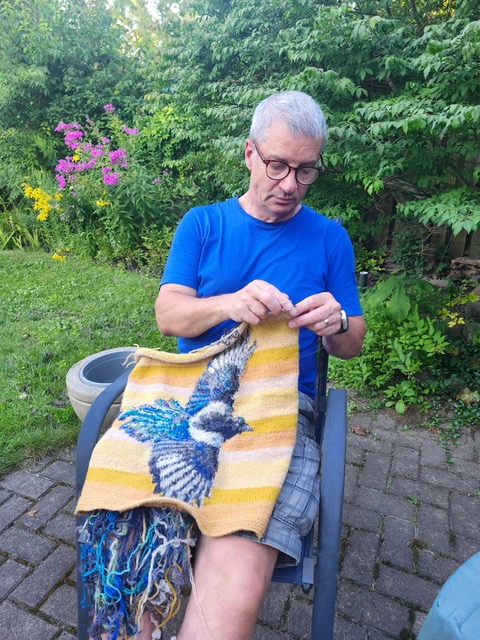
What knitted item are you most proud of? What did you learn while working on it?
I am proudest of my two largest knitting projects. The first being Stitched Glass, mentioned above. That project was the genesis for writing the play The Knitting Pilgrim with my wife, Claire, which has toured in 6 countries for over 120 shows. The second large project was The Patchwork Pride Project, a huge pride flag comprised of 6” knitted or crocheted squares, sourced from all over the continent and then assembled by the LGBTQI community and their supporters. In 2024 it was hung from the bell tower of Morningside-High Park Presbyterian Church, and in 2025, it was displayed on the facade of Canada House in Trafalgar Square, London, UK. I think the thing that makes me proudest of those two projects is not just the knitting that went into them, but rather what they say: the message they give to the world. Life is about compassion, peace, and empathy for others. Without really realizing what I was doing, I stepped into Craftivism – the art of gentle protest. And that is now a big part of how I see myself, and what I want to do in the future.
What is your day job? How, if at all, does knitting fit with that?
I work as a corporate trainer in the customer service space. I give customer-centric feedback to corporations to let them know how they are being experienced by their customers, and what they can do to improve their customer relationships. Knitting doesn’t really fit in with it, although my company has been very supportive of my work (my boss is one of my biggest fans), and since the advent of zoom I have become adept at knitting just off screen…
Have you ever injured yourself knitting?
Fortunately, I have not. Because most of what I do is colourwork, I very rarely make exactly the same motion for very long – so I’m not prone to any repetitive motion injuries. I’m often stopping to find new yarn, add colours, or work colours in. I’ve developed my own two-handed technique for working with multiple colours and strands, and that keeps my range of motion pretty good.
Do you consider yourself to be a process knitter or a product knitter?
I’m a bit of both, really. I am always knitting with a product in mind – a sweater, a mitten, a blanket, a pillow – but because it is usually my own design, I need to experiment with the process as I go. This is most often about colour, but a few times it has been about shaping and gauge – as was the case for one of the sweaters I knitted for Spycraft, a play Claire and I wrote about a 50-year-old woman in WW II who was tapped by Winston Churchill’s Special Operations Executive (SOE) to spy on the Nazis in occupied France, and sent coded intelligence back to England in her knitting. I was knitting a form-fitting intarsia sweater for one of the actors, and the sizing just about drove me around the bend.
Do you have a favourite stitch pattern? If so, what do you like about it?
Sadly, I default to plain old stockinette stitch most of the time. This is because I’m all about colour and I often design representational patterns, and stockinette is a great canvas on which to ‘paint.’ That said, I do have an intense admiration for cables, and would dearly love to knit a Gansey. Perhaps someday…


