
By Genevieve Chornenki
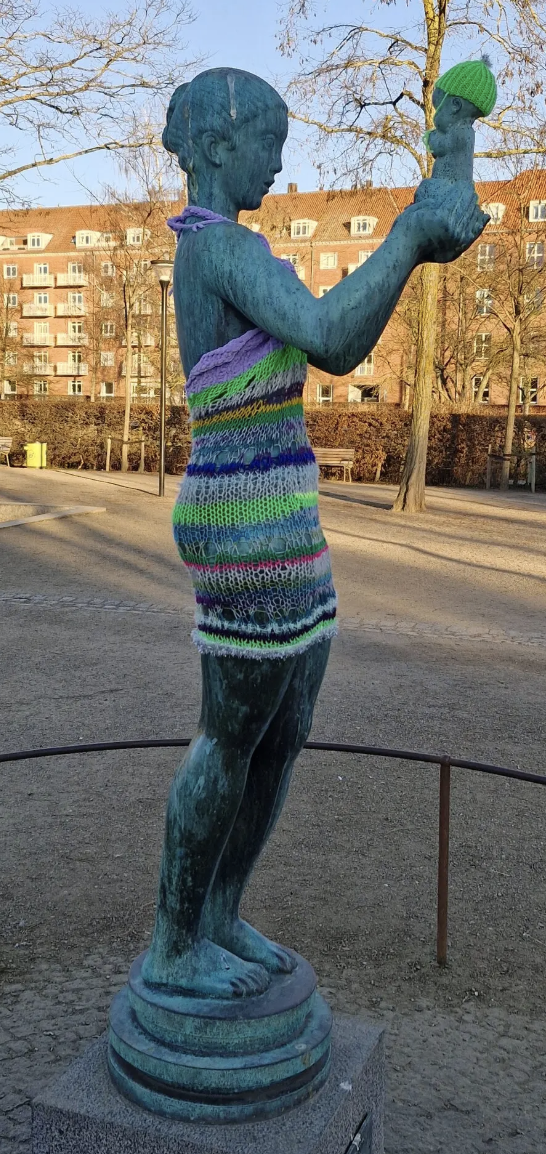
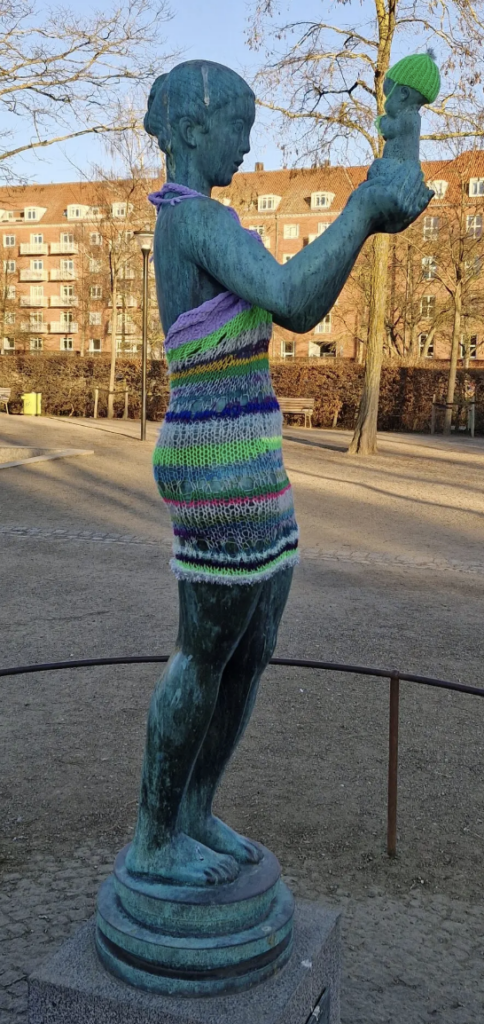
Louise Moerup’s yarn-bombed Venus statue in Copenhagen, Denmark
Until recently, yarn bombing—also known as guerilla knitting—wasn’t my thing. It had the aesthetic appeal of a sink of dirty dishes or a pile of soiled laundry, and military terminology is inconsistent with our gentle needle art. Yet the chaos of yarn-based graffiti is what makes it effective as a public statement or a social critique. One doesn’t ordinarily find a pride flag on a tree, for instance.
Yarn bombing was put to good use recently in Denmark where public monuments of historically-significant males appear ten times more frequently than monuments of females. Avid knitter Louise Moerup wanted to point out that discrepancy, so she knit and dressed one of Copenhagen’s Venus statues in a striped halter dress and thereby started a national conversation. Moerup said that she wanted to highlight the absence of women remembered for their achievements.
Moerup wasn’t concerned with public nudity, apparently accepting the chauvinism built into Western art. But is nudity separable from the numbers? I suggest that they converge in the same prejudice.Female nudes overwhelmingly outnumber male nudes in Western art, but that discrepancy seems to be an acceptable one, and outside gallery walls, the display of female pits and parts goes mostly unremarked. That said, painter John Berger’s observation in Ways of Seeing (1972) may still be relevant:
Men act and women appear. Men look at women. Women watch themselves being looked at. This determines not only most relations between men and women but also the relation of women to themselves. The surveyor of woman in herself is male: the surveyed is female. Thus she turns herself into an object of vision: a sight.
Which brings me to my pending yarn bombing.
On Plot O, Lot 18 in Toronto’s Mount Pleasant Cemetery, the merchant Lionel Cutten erected a monument with two unclothed figures that, according to The Mount Pleasant Group’s website, are believed to represent Cutten’s wife, Annie Rowena, and her sister, Helen Gertrude Moncur, who died within months of each other. The website describes the monument as one of the cemetery’s “most captivating memorials,” but every time my friend Donna and I pass by we cringe and shake our heads. How, we wonder, is this a dignified memorial to the deceased women? Is there the remotest chance that they authorized these representations?
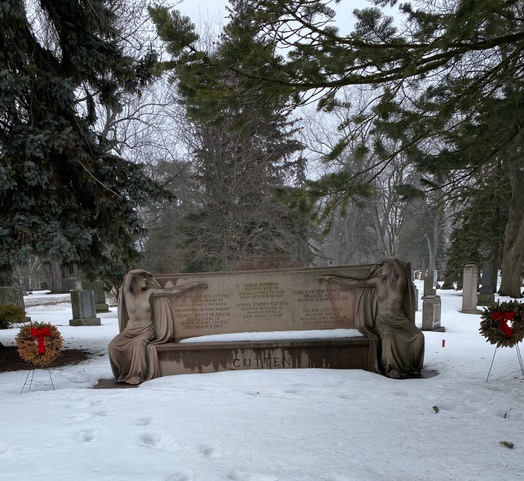
The Cutten monument, Mount Pleasant Cemetery, Toronto
Annie and Gertrude are seated at either end of a long bench, partially draped in bedsheets, bare arms above their heads revealing hairless arm pits, and smooth, lithe bodies exposed from the navel up. Rain or shine, winter blizzard or summer heatwave, the bare-breasted ladies recline. Berger again:
To be naked is to be oneself. To be nude is to be seen naked by others and yet not recognized for oneself.
Oh, how Donna and I want to offer Annie and Gertrude the dignity of clothing!
Donna doesn’t knit, however, so I’m elected to produce yards and yards of fabric. But here’s the real concern: will the Mount Pleasant Group consider our cover-ups an act of kindness or an act of vandalism?


